
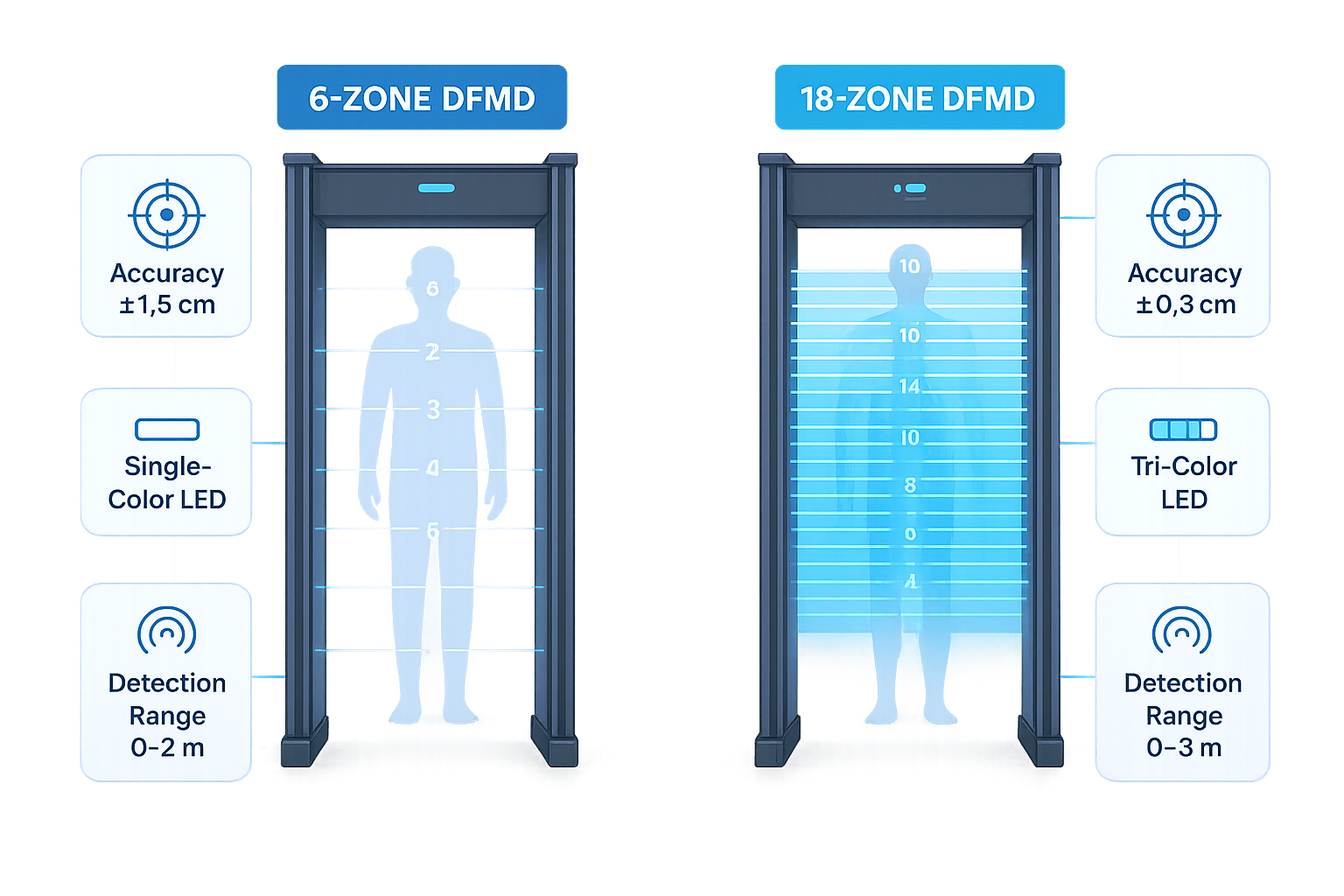
When upgrading your facility’s security, choosing between a 6 zone vs 18 zone DFMD can feel overwhelming. Both have distinct advantages depending on use case, traffic volume, and detection accuracy required. In this blog, we’ll help you evaluate which DFMD solution is the perfect fit for your setup.
What Are Zones in DFMDs?
Zones in a door frame metal detector refer to vertical detection segments that allow the system to locate metallic objects on different body areas.
- 6 Zone DFMDs: Divide the body into broad regions head, torso, and lower body.
- 18 Zone DFMDs: Offer finer detection, identifying specific threat areas more accurately.
Feature Comparison: 6 Zone vs 18 Zone DFMD
| Feature | 6 Zone DFMD | 18 Zone DFMD |
|---|---|---|
| Detection Accuracy | Moderate | Very High |
| Ideal For | Malls, schools, basic event screening | Airports, VIP security, government buildings |
| False Alarm Control | Basic filtering | Advanced false alarm reduction |
| Price Range | Budget-friendly | Premium |
| LED Indicators | Fewer zones lit | Pinpoint-level lighting |
| Crowd Handling | Medium traffic | High traffic zones |
When to Choose a 6-Zone DFMD
- You operate a mall, multiplex, school, or small event venue.
- You want basic threat detection at a cost-effective price.
- Throughput is moderate (20–30 people/minute).
When to Choose an 18-Zone DFMD
- You need precise object location detection.
- You’re securing airports, high risk events, or government offices.
- Traffic is heavy 40–60+ people per minute.
- You require custom sensitivity per zone for refined control.
Choosing between a 6 zone vs 18 zone DFMD ultimately depends on your security requirements and budget. For high risk environments demanding precision and speed, an 18 zone model is unmatched. For moderate security needs, a 6 zone system provides effective screening without overinvestment.